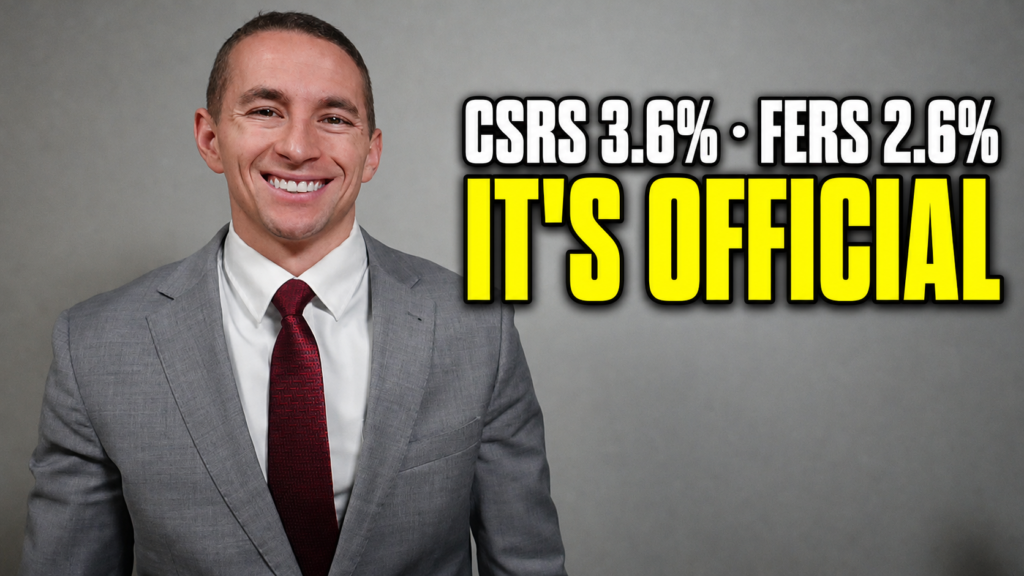
It’s official. Social Security and CSRS retirees will get a 3.6% cost-of-living adjustment for 2027. FERS retirees will get 2.6%.
In my work as a financial planner for federal employees, COLA Day always brings the same question: “Why is my number smaller?” If you’re under FERS, the answer is built into the law. Here’s what you’re getting, why, and when you’ll see it.
Why FERS Retirees Get Less
CSRS annuitants get the full COLA, the same as Social Security. FERS annuitants get what’s often called the “diet COLA.”
The FERS COLA depends on how much prices rose, measured by the CPI-W:
| If the CPI-W rises… | FERS retirees get… |
|---|---|
| 2% or less | The full increase |
| More than 2%, up to 3% | A flat 2% |
| More than 3% | The increase minus 1 point |
This year’s increase was 3.6%, which puts FERS in the third band. Subtract one point and you get 2.6%.
That one point matters more than it looks. It repeats every year inflation runs above 3%, and each smaller raise becomes the base for the next one.
What It Means in Dollars
Take a retiree with a $2,000 monthly annuity.
- CSRS: 3.6% adds $72 a month, or $864 a year.
- FERS: 2.6% adds $52 a month, or $624 a year.
That’s a $20-a-month gap on the same annuity in a single year. Over a 25- or 30-year retirement, the gap compounds. This is why I tell FERS clients to plan for inflation with their TSP and Social Security, not just their pension.
Who Gets It (and Who Has to Wait)
Not every FERS retiree gets a COLA this year.
- CSRS annuitants: everyone gets it, at any age.
- Regular FERS retirees: you don’t get COLAs until you turn 62.
- FERS retirees who get it before 62: disability retirees, survivor annuitants, and special-provision retirees such as law enforcement officers, firefighters, and air traffic controllers.
If you retired at your MRA and you’re 58, your annuity stays flat until 62.
One more point catches many people off guard. The FERS Supplement never gets a COLA. If you’re living on your annuity plus the Supplement before 62, neither piece rises with inflation.
When You’ll See It
The COLA takes effect December 1. Because annuities are paid a month behind, you’ll see it in your January 2027 payment.
If you retired during 2026, your first COLA is prorated. You get 1/12 of the full adjustment for each month you were on the annuity rolls. Someone who retired in the fall will see only a small first bump. The full COLA kicks in the following year.
The Number That Can Eat Your Raise
The COLA is only half the story. OPM announced that average FEHB enrollee premiums are going up 10.9% for 2027.
Your FEHB premium comes out of your annuity. For many retirees, a 10.9% jump in premiums will take back a large part of a 2.6% raise. Your exact result depends on your plan and your annuity amount.
The good news is that Open Season runs November 9 through December 14, 2026. That’s your chance to compare plans before the new premiums hit. If your plan is leaving FEHB in 2027 and you don’t choose a new one, OPM will choose for you.
Final Thoughts
CSRS retirees get the full 3.6%. FERS retirees get 2.6%, and only from age 62 unless they fall into one of the exceptions. The Supplement gets nothing.
The smartest move this month is to plug your own annuity into the formula. Then check what your FEHB plan will cost in 2027 and see what your January check will actually look like. If the numbers feel tight, now is the time to adjust your TSP withdrawals or your plan choice, not after the first check arrives.
If you’re a federal employee within 12 months of retirement, or already retired, with $1 million or more invested, book a free 15-minute Fit Call to see if we can help: https://app.hawsfederaladvisors.com/whatservicemakessense
Dallen Haws, CFP®, is the founder of Haws Federal Advisors, which helps federal employees plan their retirement. This article is educational only and is not tax, investment or legal advice. HawsFederalAdvisors.com